
As a girl, I struggled to grasp the concept of love and relationships. My divorced parents still shared a home despite my father’s history of violence and infidelity, and the adults around me were stuck in complex, unhealthy relationships. Women, like my mother, who end up in traditional heteronormative relationships, frequently end up settling with men who do not value them as partners. Not only is this dynamic evident in the real world, but film and media also heavily corroborate the war on women’s happiness in terms of love and romance by introducing tropes, like “the incompetent boyfriend or husband.”
“The incompetent boyfriend or husband” is a man who fails to get it right, but at least he’s trying, or to some degree, means well. They forget anniversaries, birthdays, and other meaningful occasions. They prioritize themselves first, and the partner’s and/or children’s needs second. These characters land themselves in predicaments that could have been avoided had they been more considerate of those around them. And it is not solely a one-time offense; their behavior remains a main plot point at the expense of the women around them.
The female characters are expected to bear the brunt of their male partners’ egoism. Instead of seeking better, they are forced to forgive and settle. These characters exemplify society’s definition of a “perfect woman.” She is supposed to have no thoughts or ambitions, which center herself. Her sole purpose is to support her male partner in any way, shape, or form. However, it is not these female characters’ fault that their storyline revolves around men.
Throughout television and film, the presence of women in screenwriting has yo-yoed back and forth. Although women behind the camera were often undervalued and underrepresented, the most successful screenwriters of the silent film era were, in fact, women. However, a shift occurred around the late 1920s; the field became more lucrative, and the introduction of “talkies” increased the demand for playwrights and journalists who could write dialogue. A similar transformation occurred regarding novelists in the late nineteenth century. Once authorship entered the realm of “male work,” women were pushed out.
Male writers depicted what they saw, and what they saw is a society that did not see women worthy of having a story told. Women were assigned subservient roles that did not extend beyond those of homemaker, emotional caretaker, or damsel in distress. Male writers were not challenged to reflect on women’s position in society, which resulted in stagnant female character tropes. To them, much like the rest of the world, women are not viewed as complete individuals. While women’s place in society has changed culturally, I can not help but think of the damage American sitcoms and animation have already done to the psyche of women.
The birth of American sitcoms can be traced back to the 1950s. One of the most notable sitcoms of this time is The Honeymooners. This 1955 classic follows a specific schema that focuses on the lives of traditional married couples who embrace typical gender roles. Popular comedian Jackie Gleason stars as Ralph Kramden, the bumbling husband; in juxtaposition, Alice (played by Audrey Meadows) portrays the witty and patient wife. With only 39 episodes, The Honeymooners struggled to catch notable prominence when it first aired, yet it has gone on to be the blueprint for modern sitcoms.
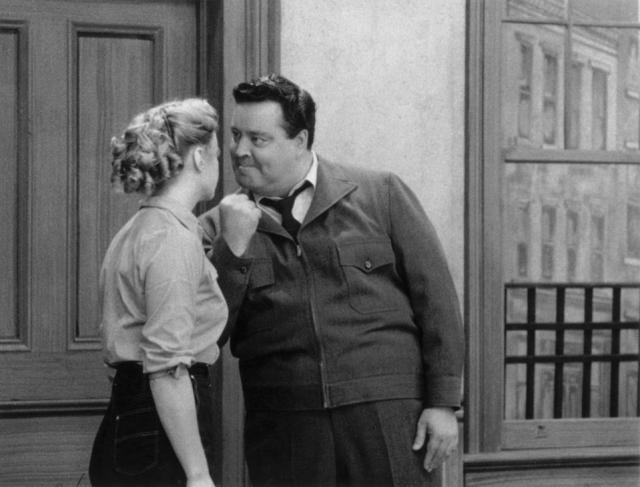
Although I had never seen the show until recently, I was familiar with one particular phrase Ralph famously adopts. He would often use dialogue and body language to issue empty threats to his wife, Alice. As Ralph waved his fists, he would say a variation of “To the moon, Alice,” insinuating some sort of violence strong enough to send her to the moon, then a laugh track would play. The dark joke was domestic violence, and the sick, twisted punchline was Alice and women like her. Ralph’s behavior reinforced America’s longstanding dismissive perception of women’s personhood.
A commonality with these shows is a hard-working man who would demean his wife when she did not adhere to his viewpoint. The fact that she can express her opinion openly seems more like an allowance. In All in the Family (1971-1979), the main character, Archie Bunker, exhibits a multitude of personality flaws. He is an everyday bigoted conservative blue-collar worker and alleged family man. Edith, Archie’s wife, a lovable yapper, was frequently silenced by her husband with one word, “stifle.” Imagine existing as yourself and having a partner who sees your eccentricity as a nuisance. On and off screen, women like Edith are subjected to subpar treatment packaged as love. Creator of the show, Norman Lear, drew inspiration from his father, who would tell Lear’s mother to “stifle.” Since women in real life were not valued, women in TV and Hollywood succumbed to the same fate.
I remember browsing through channels for something to watch, and then stumbling on Married with Children (1987-1997). The family in the show, the Bundys, had a seemingly normal family dynamic for that time: a stay-at-home wife, a working father, a teenage daughter, and a smart-aleck son. As I watched the show more closely, I noticed the tense relationship between Al, the father, and Peggy, the wife. Al has such an ugly spirit. He comes home, complains, and neglects his family. Peggy mirrors the life of most housewives, trying to make the best of a bad situation.
Andre Johnson from Black-ish (2014-2022), Hal from Malcolm in the Middle (2000-2006), and Phil Dunphy from Modern Family (2009-2020) are a step up from the outdated sitcoms I have previously mentioned, but not by much. Each of these dads is sick with man-child syndrome. They’re partners are forced to pick up the slack and parent their adult husbands. Claire, Phil’s wife, is forced to assume the overbearing parent role, while Phil just gets by on being the goofy, fun dad with no responsibilities. To cope, Claire drinks, but her drinking is not supposed to be considered an addiction to those around her or the audience. Since she is ultimately “just” a woman, her addiction is presumed to be a“cute habit” rather than a serious problem.
Drinking becomes an escape for many television mothers and housewives. Instead of leaving, they drink. They stay, not for themselves, but because their story begins and ends with their inattentive, blundering male counterpart. Their drinking is not addressed unless followed by a joke, as if to say, their pain is not real. Even animated female characters drink to satiate their desire for better. Lois from Family Guy and Francine from American Dad are mothers, wives, and heavy drinkers.
I grew up on cartoons, they were my favorite thing to watch as a child and even as an adult. Some of my favorites include: Billy and Mandy, The Simpsons, and Courage the Cowardly Dog. Little me thought these shows were a hoot, especially the bumbling fathers who always made me laugh. It was not until I got older and rewatched some of these shows that something felt off. It started as a slight annoyance, but as I watched these characters fumble about with the empathy of a newborn, I was disturbed.
They reflected briefly or not at all, then continued to be a nuisance to their female partners for the rest of the show. It was blatantly obvious their lack of care was not just a cute quirk, but rather a failing of society. Men are given passes to be terrible partners, husbands, and fathers, while women are programmed to provide endlessly until nothing is left. Young girls first observe their mothers giving to the point of self-harm and tolerating disrespect, then they witness it on television and film, which warps their perception of healthy relationships.
It is not fair that love needs chasing, and women are the only ones socialized to chase it. Through social media, we gain access (to some degree) to numerous couples’ intimate relationships. As societal bystanders, we watch as women’s pain is turned into think pieces and comedic parodies. Women become laughing stocks because the supposed love of their lives would rather embarrass them than show affection. The world does not condemn the poor behavior of men enough, so they often get by with doing just enough, or even less. Women bear the brunt of social ridicule and risk their image every time they tolerate mistreatment from their male partners.
Leaving is not much of an option when young girls and women have been conditioned to stay and endure. I understand it can be difficult to choose yourself when distorted notions of empathy have been shoved down your throat. However, demand more because you are worthy of everything you ask for, despite society’s conviction. Women deserve to be happy, too.
Some Honorable Mentions in no particular order:
Frank from Moesha
Martin from Martin
Randy Marsh from South Park
Ross from Friends
Big from Sex and the City
Peter Griffin from Family Guy (Evil)
Every Tyler Perry Movie Ever

 THE 20-SOMETHING FILES.
