

I’ll admit it, the first time I watched Josie and The Pussycats (2001), I didn’t like it.
The film was largely panned upon its release 24 years ago, largely because audiences were confused by it. Its PG-13 rating seemingly placed it amongst the abundance of raunchier teen comedies of the 90s and 2000s—much like the writer/director’s previous hit Can’t Hardly Wait (1998)—but the nostalgic (and intrinsically more juvenile) premise seemed more in line with the constant rehashings of older material that were being produced for the younger generation.
But now that I have revisited the film and lost myself amidst the clouds of body glitter and the lowest of low-rise jeans, I’d like to amend that previous statement.
It’s not that I didn’t like Josie; it’s more that I didn’t get it.
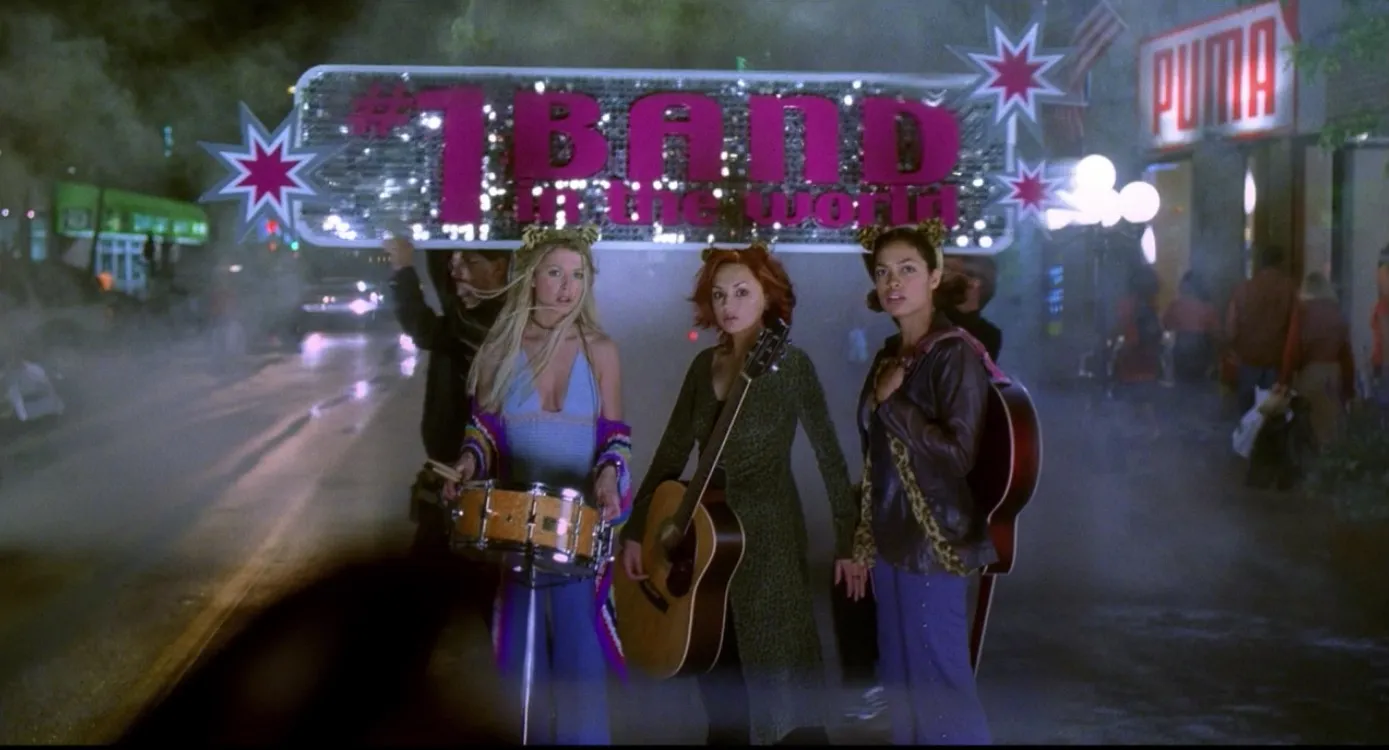
I went into Deborah Kaplan and Harry Elfont’s glittery satire, not actually knowing it was a satire, and expected it to be more in line with their previous endeavors. A Very Brady Sequel and The Flintstones in Viva Rock Vegas, like Josie, adapt nostalgic TV properties from the 1960s/70s for the big screen. Both films (which happen to be sequels, though Kaplan and Elfont were not involved with the initial installments) heavily play with their source material, attempting to modernize the environment but not the characters, which becomes the crux for the story at hand (more so in the case of A Very Brady Sequel). The Scooby-Doo movies written by James Gunn in 2002 and 2004 do the same thing. The built-in nostalgia becomes part of the charm, the cheese. And even now with the reevaluation of the film, we see it is largely built upon the nostalgia that Millennials and Gen Z have for an underappreciated film from their own childhood.
In short, I went into Josie expecting that it would be the story of a girl group with an image akin to the Ronettes and Lesley Gore, or perhaps directly inspired by the 1970-72 cartoon series, defying the odds and scoring it big with old-style tracks amidst a music landscape populated with Britney Spears and Christina Aguilera (both of whom actually appear as standees during the Total Request Dead fight sequence). I expected the classic cat suits and theme song. Maybe they’d even go to space like they did in the cartoon.

Instead, I was treated to the (then) contemporary vocal stylings of Kay Hanley of Letters to Cleo and a pop punk soundtrack, ripped from an era of radio I only vaguely recall. Rather than rehashing the storylines we’d seen a million times before and have seen again another million since, Josie did something different, something new, with an older property. It held up a mirror to how the cultural consciousness operates, how it purchases, and how it is sold to, a mirror that has only gotten shinier in our digital age.

We live in a time of perpetual advertisement. From the physical dinosaurs of billboards and print ads to influencers on social media, everywhere you look there is an ad, a cure, or the perfect white t-shirt promising weight loss and clear skin. The answers to the universe and life itself are just a DM or a “link in bio” away. Consciously and unconsciously, we are always being advertised to, which is only a small fragment of what makes Josie and The Pussycats such a fascinating watch 24 years after it bombed at the box office.
Every frame of the film—based on the Archie Comics property of the same name—is stuffed to the gills with advertisements and logos. Between a Target-themed hotel room and private plane, a McDonald’s-themed shower with a french fry sponge, and product placements featuring everything from Steve Madden to Sega, it feels like overkill, even to the modern and constant consumer. You’d think that the directors are selling out, giving advertisement space to any and everyone—even working with the likes of Coke to create in-universe branded cans—but they weren’t paid for a single placement. Kaplan and Elfont included these brands willingly as a part of their critique of consumer culture and advertising.This strategy only further played with the idea of subliminal messaging that reverberates throughout the plot.

Everything is an ad, and at the same time, nothing is an ad. The brands, storefronts, and billboards are just a part of the backdrop of the film, a backdrop of the 21st century. The creators obviously had no idea of how the next quarter century would unfold or how advancements in technology would impact the way we buy and sell. But it is easy to see the connective tissue between the evil trend-developing lab in the basement of Mega Records and how trends form on social media, specifically TikTok.
In the trend lab there are teams manufacturing everything from what will become the latest fashion trend—which involves an orange and yellow feathered outfit they call a cross between “Buffy and Chicken Run”—to new slang—in this case “jerkin”—to the trending color of the week—which we can see shift from pink to orange to blue to purple as the film progresses. In the background we can see tallies counting the sales of TVs, CDs, concert tickets, and more.
For the modern viewer it’s easy to make comparisons to our own ever-shifting fashion and aesthetic trends, like “tomato girl,” “blueberry milk nails,” or the infamous “mob wife aesthetic,” all of them vanishing just as soon as they appeared on our screens. But rather than a shadowy organization deciding our “fads, fashions, and product placements,” it’s a collection of influencers dictating what colors are in for the summer, what patterns are out, and what items you just need to toss in with your latest fast fashion haul.

Our consumerist reality is perhaps more insidious than that of the film. While both the titular Josie and the Pussycats and the NSYNC-style boy band Du Jour do brand deals and know they have some base level of influence over their fans, they don’t know, at the start, how far they are being manipulated and used to control the economy. Once they learn they’re complicit, they are targeted by Mega Records and cast aside. At the start of the film, Wyatt Frame (Alan Cummings) causes Du Jour’s plane to crash once they wise up and notice the message underneath the tracks of their latest single. Pussycats Valerie Brown (Rosario Dawson) and Melody Valentine (Tara Reid) are repeatedly put into situations where they are meant to die as they begin to suspect their label of wrongdoing.
The influencers we watch on our screens know they are selling to us. They link every item of clothing in their Amazon storefront or TikTok shop. They purchase things by the truckload just to stay ahead of and to create trends while normalizing wasteful standards and promoting fast fashion. This behavior is not a side effect of young and hopeful rock stars finally catching a break but the core of their public existence. To stay relevant, you have to reinvent, and to reinvent, you have to purchase; you have to sell and transform into something aspirational and unattainable. You prey on people’s insecurities and flaunt vacations or items impossible to fathom to the average person and consumer.
I didn’t like Josie and the Pussycats when I first watched it in December of 2024, but I have grown to love it. My discomfort came from the fact that it was so different from the nostalgia-bait rehashing present in other films from that era (which I also adore) and attempted to create something that both reflected the core of the characters from the Archie comic and Hanna-Barbera cartoon, the central friendship that ends up saving the day, but also something that reflected the times, trends, and music of the time it was written and produced in.
One of the most enduring jokes or aspects of the subliminal messaging is the phrase “Josie and the Pussycats is the best movie ever,” which flashes on the screen during the final confrontation along with the words “Join the army.” You’ll find it spread throughout Letterboxd reviews both sincerely and satirically, tucked within articles or even as the title of an oral history of the film, its production, and its legacy by Russ Burlingame.
Is Josie the best movie ever? Not necessarily. After all, it’s a product of its time in both the best and worst of ways. For every iconic outfit, makeup look, or song, we get moments that emphasize the beauty standards of 2001 “heroin chic” that can make it an uncomfortable viewing today, especially as culture is swinging back to that toxic peak. But all that is to say that it’s certainly not as bad as we were all led to believe.
In fact, in an era where everything old is new again, where trends are taking over our lives… Josie and The Pussycats is a story we need now more than ever.


 THE 20-SOMETHING FILES.