
The goal for the night is lemon bars. My hands gather my more-orange-than-blonde hair (the result of a COVID-era, depression-induced bleach job) into a ponytail. I throw on an apron and splay the assortment of mixing bowls and spoons and ingredients out onto the kitchen counter. At twenty years old, I’ve found solace in baking—the measured routine helps distract me from the stress of my college classes, and the edible reward fills me with the satisfaction of a job well done.
My phone timer sounds at around 8 PM. The oven’s heat warms my face as I pull the pastry’s base, a shortbread crust, out and onto the counter.
Even before the metal pan clanks down, I can tell that something’s off.
Quickly, I grab my phone and scroll down the recipe’s webpage. The reference photo features an even layer of golden-brown shortbread, with a caption indicating it should be “snappy.” I bring a piece of crust between my thumb and forefinger to test the texture, and it squishes like gum. A bit of oil leaks out where I press down. Not ideal.
I convince myself that I just didn’t bake it for long enough. I slide the pan back into the oven and set another timer. I pace the kitchen as I wait.
When I remove the pan from the oven, the shortbread looks even worse. It’s greasier and gummier to the touch and speckled with dark brown burns.
By the end of the night, all I have is an unsalvageable shortbread and a messy kitchen. Not a single lemon bar for my effort.
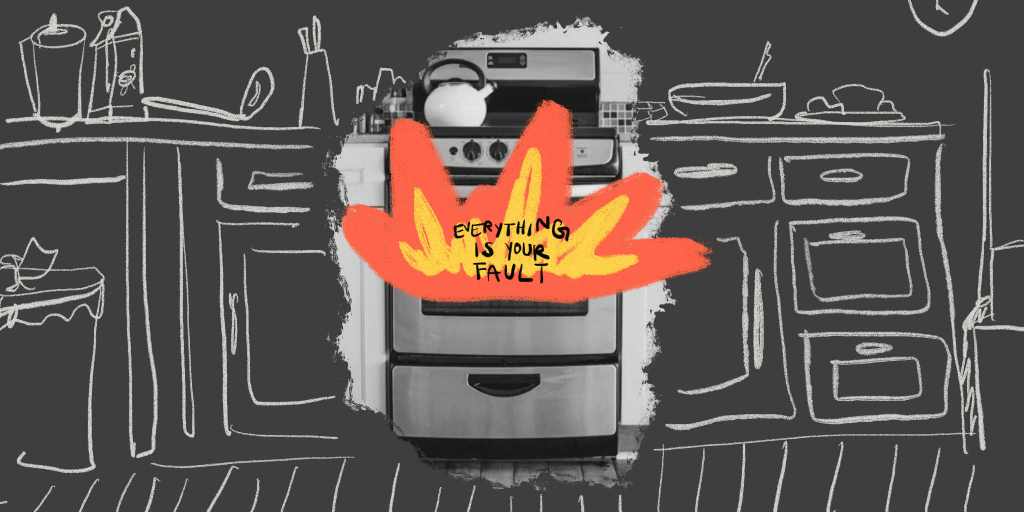
At twenty years old, the only way my body responds to disappointment is blame. I freeze, hunched over the kitchen table as my skull pounds with frustration—blaming myself for making a mistake somewhere along the recipe lines.
Blaming myself for trying to bake in the first place.
Blaming myself for existing at all.
At twenty-four, I’m on the way to the emergency room. My throat is closing up, and I need to focus on pushing air to my lungs while my friend drives toward the hospital. This is not what I had planned for the day.
In the excitement of reconnecting with a friend for the first time in years, I forget to ask the cashier about my order’s ingredients. After the first bite, my taste goes metallic, and I know.
On a few levels—mortally, socially, perfectionistically—this is a catastrophic event. This might even warrant a freak-out. Nobody could fault me for a reaction of fear and tears and panic. Physically, I’m dying.
But the tears never come, and my brain unscrambles into a to-do list.
Inject myself with an EpiPen.
Ask my friend for a ride to the ER.
Breathe in.
Breathe out.
Breathe in.
Breathe out.
At twenty-four, a lot about myself is the same as it was four years ago. But in some crucial ways, I’m so different. The voice in my head is much kinder. She’s a friend.
“You wouldn’t expect a friend to be perfect at everything they do,” my therapist preaches, just as she’s done many times before. “So why do you expect that of yourself?”
The first time she says this, I press my lips into a tight smile and nod politely. It seems like a nonsense question—isn’t self-critique proof that I want to be a better version of myself? Isn’t that a good thing?
She raises a brow. “Do you think it’s realistic that you’ll never make a mistake?”
Everybody makes mistakes, the old saying says (thanks, Hannah Montana!). But when I replace “everyone” with the pronoun “I,” it’s hard to finish the sentence.
“Think about a time you’ve made a mistake recently,” she says. “Even if it was a big one, the world didn’t end. You did what you had to do to manage the situation, then life went on. That’s a good outcome.”
It takes four years for this conversation to stick—for the voice in my head to be gracious by default. Sometimes, the perfectionist persona emerges first, but I remember eventually.
In prior years, the voice in my head would reprimand me for not remembering to ask about allergens. I’d blame myself for trying something new. Eventually, I’d blame myself for existing.
She would say that I ruined the meetup with my friend by having a medical emergency. I’d blame myself for inconveniencing them by asking for a ride to the hospital. Eventually, I’d blame myself for existing.
I would worry myself even sicker by thinking about paying the hospital bills. About having to buy another set of EpiPens, which were already notoriously expensive. About stressing out my parents once I told them. I would think that all of this would be easier if I didn’t exist.
But in the restaurant, in the car, and in the hospital bed, I’m simply focused on getting air into my lungs. The voice in my head tells me that I will get through it. She says that I can deal with the aftermath when it comes to it. She says that the most important thing is that I continue breathing.
She makes a note to be thankful.
I’m thankful to my friend for assuring me that I didn’t need to keep apologizing for needing a ride. I’m thankful that I get to be friends with great people like her. I’m thankful that even in this bizarre situation, we got to reconnect.
I’m thankful to my parents, who always made sure I had an EpiPen with me for times like this. I’m thankful that they dropped everything to meet me in the emergency room to make sure I was okay. I’m thankful that they helped me talk to the doctors.
I’m thankful to myself, having done the work that let me keep calm in the face of swollen lips and a lack of oxygen.
That isn’t to say that I wasn’t upset. In the days following my ER visit, I subconsciously knew I wouldn’t have to deal with insurance and hospital bills and missed work if I didn’t make the mistake that landed me in my situation. I wasn’t enthusiastic to do it by any means—I even cried a few times in the process.
I had spent years in routine with salted tears running down my face. They accompanied every disappointment—every failed baking session, every sub-optimal exam, every changed plan—without fail.
But, at twenty-four, I wasn’t blaming myself. I could be disappointed without retreating into blame. I could acknowledge a mistake or worry about the future without snowballing into self-hatred. I could cry while feeling gratitude that I was alive. And the next time I mess up a batch of lemon bars, I’ll give myself the freedom to do the same.

 THE 20-SOMETHING FILES.